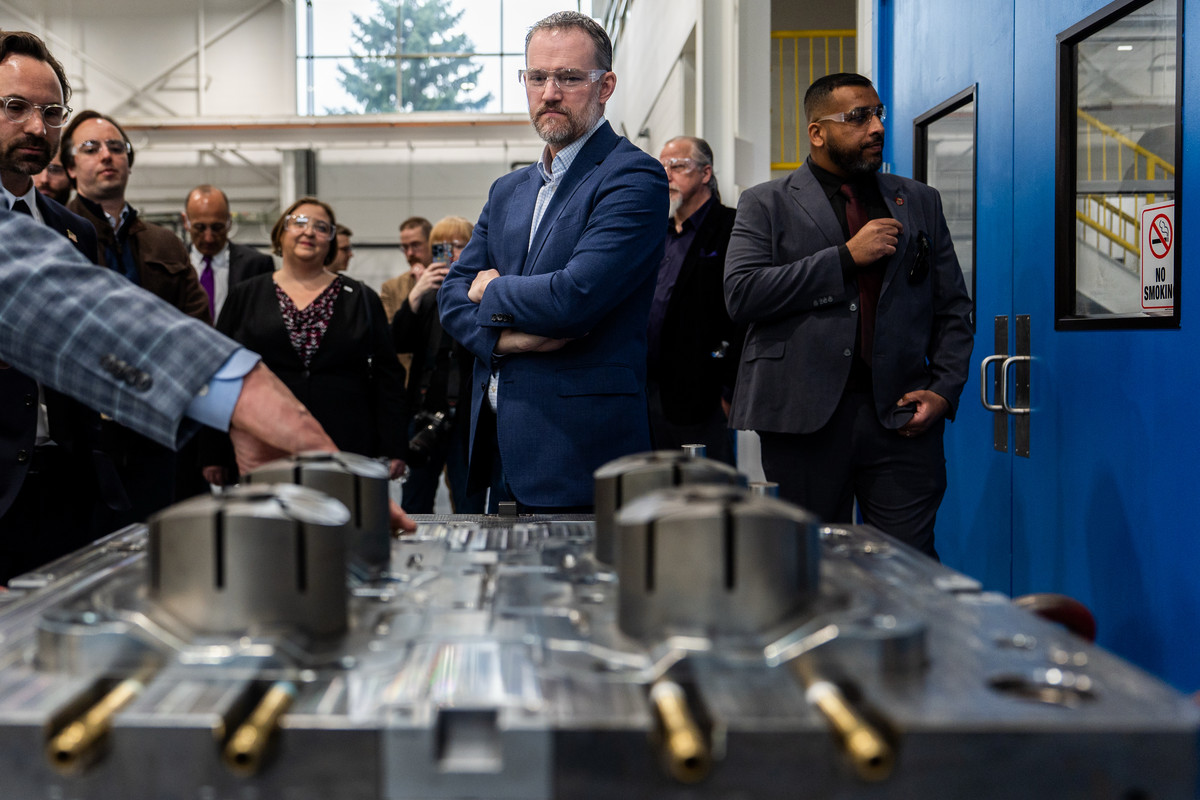
— On a cloudy morning inside a Michigan factory, Jamieson Greer stood before an American flag large enough to hide an elephant, selling President Donald Trump’s trade agenda to a man who hopes to become the state’s next governor. Then that man, Representative John James, went soft on the core tenet of Trump’s efforts to reshape global commerce. “We don’t want the tariffs to go on forever,” James said, standing beside the nation’s top trade official. Greer stared off at a machine in the distance.
Greer, a well-respected trade lawyer handpicked by Trump to serve as U.S. Trade Representative, has heard similar lines from tariff-skittish Republicans before. They frame the duties as a negotiating tool, a lever to force other countries to open their markets and expand American exports, after which the tariffs would come down. But those reassurances contradict the daily reality of his job. His boss does want tariffs to go on forever, and Greer has been tasked with making sure they do.
Trump has never hidden his affinity for tariffs, but his second term has seen the so-called “Tariff Man” unleashed in ways that have upended global markets. He quickly imposed duties on three of the country’s top trading partners — China, Canada and Mexico — and followed with “Liberation Day,” when he levied tariffs on goods from nearly every country in the world. The stated goal was to end what the administration calls the global exploitation of American commerce and spark a grand resurgence in domestic manufacturing.
To justify those tariffs, Trump invoked the International Emergency Economic Powers Act, a law that allows the president to regulate trade during a national emergency. He argued that the trade deficit between the United States and other countries constituted such an emergency. The law had never been used for that purpose and does not explicitly mention tariffs. In April, the Supreme Court struck down the cornerstone of Trump’s economic agenda, ruling that the law could not be used that way.
Trump was undeterred. He vowed that his administration would find a new legal mechanism to impose tariffs, and he made Greer the person responsible for figuring out how. “This is still the president’s program,” Greer said. “It’s still his policy.” The ruling left the administration scrambling to rewrite the legal architecture of its trade war, with Greer at the center of the effort to keep the tariffs in place by any means available.
A Trade War Without a Safety Net
The tension on display in Michigan reflects a deeper divide within the Republican Party. While Trump and his trade team see tariffs as a permanent feature of the American economy, many GOP lawmakers in manufacturing-heavy states view them as a temporary bargaining chip. James, who is running for governor, represents a district where auto plants and suppliers depend on cross-border supply chains, making him especially sensitive to the costs of prolonged tariffs.
Greer, who is neither a union member nor a welder nor a manufacturer, found himself on a factory floor in one of the most politically important states in the country, defending a policy that even his Republican allies want to see end. As James spoke about the need for reciprocal and fair trade, Greer’s gaze drifted to a machine in the distance. He had heard this before. The difference now is that the Supreme Court has stripped away the legal foundation of the president’s trade war, and the man responsible for rebuilding it is standing in a factory in Michigan, trying to hold the line.