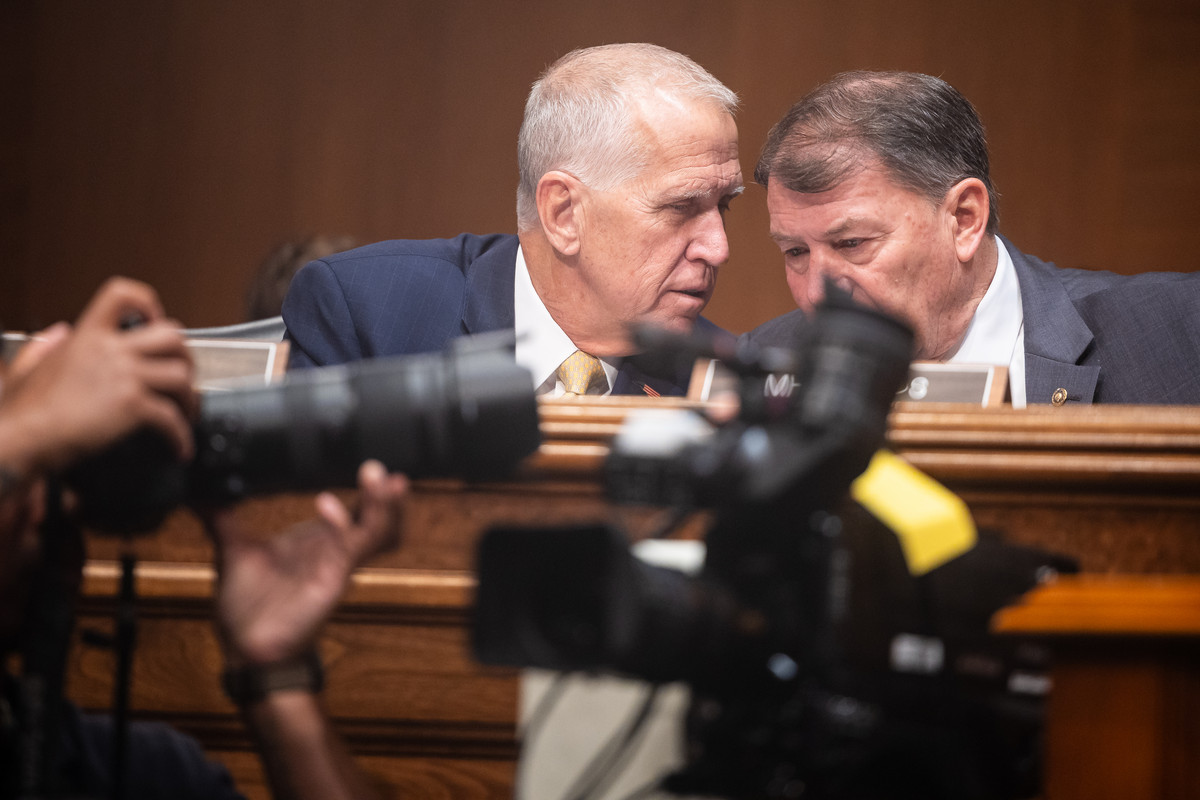
The two Republicans were conferring during a confirmation hearing, but the real business at hand was a bipartisan proposal that has put Wall Street on the back foot in a fight it is accustomed to winning.
Powerful financial interests, long accustomed to getting their way when Republicans control Washington, are on the brink of a stunning public defeat in the GOP-run Senate. Senators are poised to move forward on a measure to end a clash between banks and cryptocurrency companies, clearing the way for a landmark crypto bill to advance this month. The proposal targets rewards programs that allow certain crypto firms to pay annual percentage yield to customers who hold stablecoins, a type of digital currency designed to maintain a $1 value.
The apparent outcome of the fight shows how the crypto industry, still a relatively new special interest in Washington, is supplanting the banking sector’s entrenched lobbying power. While banks have benefited from friendlier GOP-appointed regulators during the second Trump administration, they have spent much of the last two years fighting against upstart crypto companies that have plowed hundreds of millions of dollars into political and lobbying spending. Crypto firms have employed bare-knuckle tactics to notch key policy wins.
An Existential Struggle Over Stablecoin Rewards
Both sides paint the issue as an existential struggle. Banks say the rewards programs allow crypto companies to mimic interest-bearing bank accounts and could cause customers to pull their money out of traditional institutions. For community lenders in particular, the threat is acute: smaller banks worry that a mass exodus of deposits could starve rural economies of the capital needed for loans and local development.
“It’s just this unfortunate reality that we’ve found ourselves in throughout this entire Congress,” said Christopher Williston, CEO of the Independent Bankers Association of Texas, a trade group representing small banks in the state. “Just feeling like we’re constantly pushing uphill to defend what should be absolutely sacrosanct in Congress, which is economic development, economic vitality of communities. And yet Congress at every turn just continues to prioritize so-called innovation over the health of the American economy, particularly the rural economy.”
The banking sector’s frustration underscores a broader realignment of political influence in Washington. Crypto companies have spent heavily to build relationships on both sides of the aisle, and their lobbying apparatus has matured rapidly since the last major regulatory push. The result is a rare moment when the financial establishment, which typically dominates policy debates under Republican leadership, finds itself outmaneuvered by a newer and more aggressive rival.
Senate leaders are expected to bring the stablecoin legislation to the floor in the coming weeks. If it passes, the bill would mark the most significant federal framework for digital assets to date and deliver a clear signal that the crypto industry’s investment in political capital has paid off. For Wall Street, the loss would be a bitter reminder that in the new Washington, even the most powerful incumbents can be unseated.