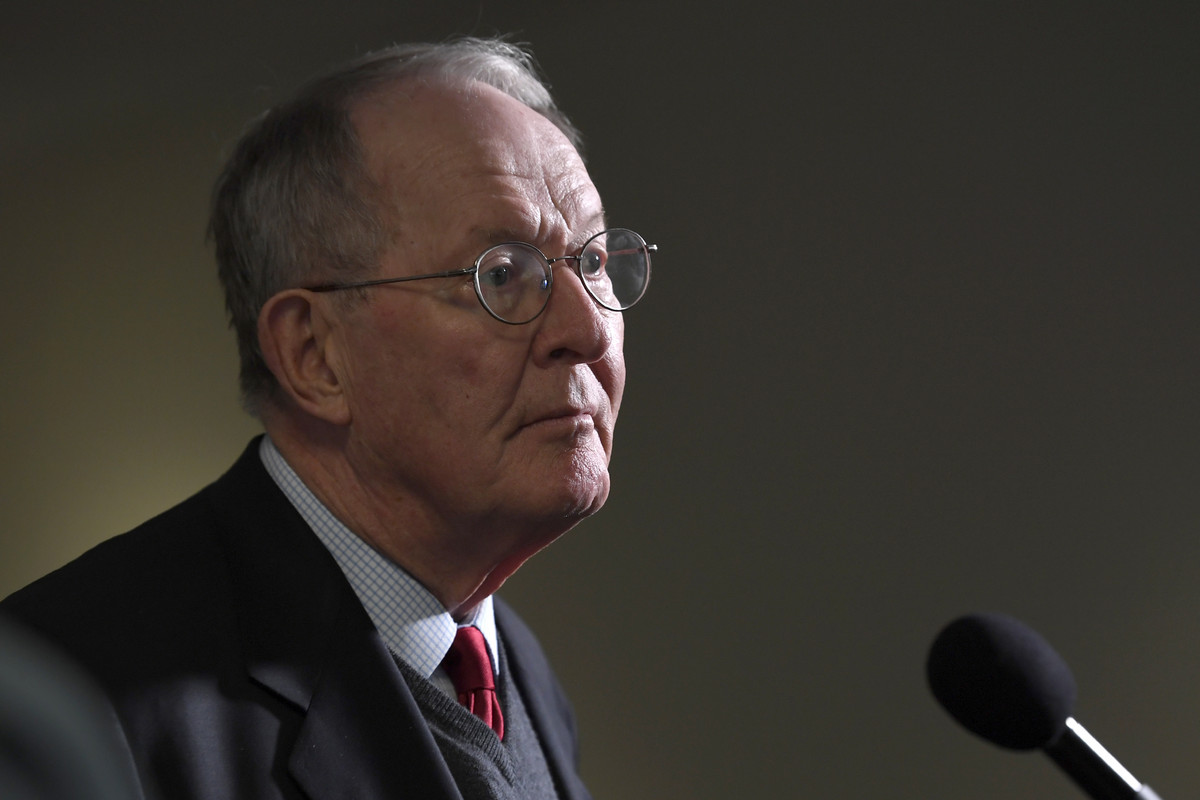
delivering his “I Have a Dream” speech on the National Mall. The young Tennessean, working for Attorney General Robert Kennedy, stepped outside to listen. Six decades later, the former governor, education secretary and three-term senator is still trying to make sense of where that march has led his party.
Alexander’s new memoir, The Education of a Senator: From JFK to Trump, arrives next week and traces an arc that touches nearly every major figure and inflection point in modern American politics. He served two terms as Tennessee governor, led the University of Tennessee, ran the Education Department under President George H.W. Bush and spent 18 years in the Senate. There were also two presidential campaigns: a credible 1996 bid that ended with a loss to Bob Dole, and a 2000 effort that collapsed before the first primary.
In an interview last month in Washington, Alexander reflected on the relationships that defined his career. His first big break came through Bud Wilkinson, the legendary University of Oklahoma football coach, who called a Nixon White House aide on Alexander’s behalf. “It’s unbelievable that I would get that job,” Alexander said. “He was the Nick Saban of the day. And he was such an impressive guy.”
The former senator acknowledged that much of political success comes down to personal connections. “And so much of this business is relationships, right? But you still gotta work hard, make your own luck,” he said. The comment carried an implicit contrast with a political era that increasingly rewards confrontation over coalition building.
Alexander’s career spanned from the Kennedy administration through the Trump presidency, and his book’s subtitle signals the ideological distance traveled. He served in the Senate during Donald Trump’s four years in office, a period that tested the institutionalist wing of the Republican Party. Alexander voted to acquit Trump during both impeachment trials but also pushed back against efforts to overturn the 2020 election results.
A Party Reckoning
Alexander suggested that his party may be ready to move beyond Trumpism, though he offered no prediction about the 2024 primaries. He noted that voters often tire of political styles that dominate for too long. The observation carried weight coming from a man who helped write the education reform law No Child Left Behind and who spent decades championing bipartisan compromise.
The memoir also revisits Alexander’s quirkier political trademarks, including the red-and-black plaid shirts and the exclamation point that followed his name on campaign materials. Those touches helped humanize a politician who moved through the highest levels of government without ever losing his Tennessee bearing. “You’ve led a political 20th to 21st century Forrest Gump-like existence,” Alexander was told during the interview. He did not disagree.
At 83, Alexander has watched the Republican Party evolve from the coalition of Nixon and Reagan into something harder to define. His book is partly an argument for the older model: the party of federalism, fiscal discipline and institutional trust. Whether that vision has a future in the GOP he helped shape remains an open question.