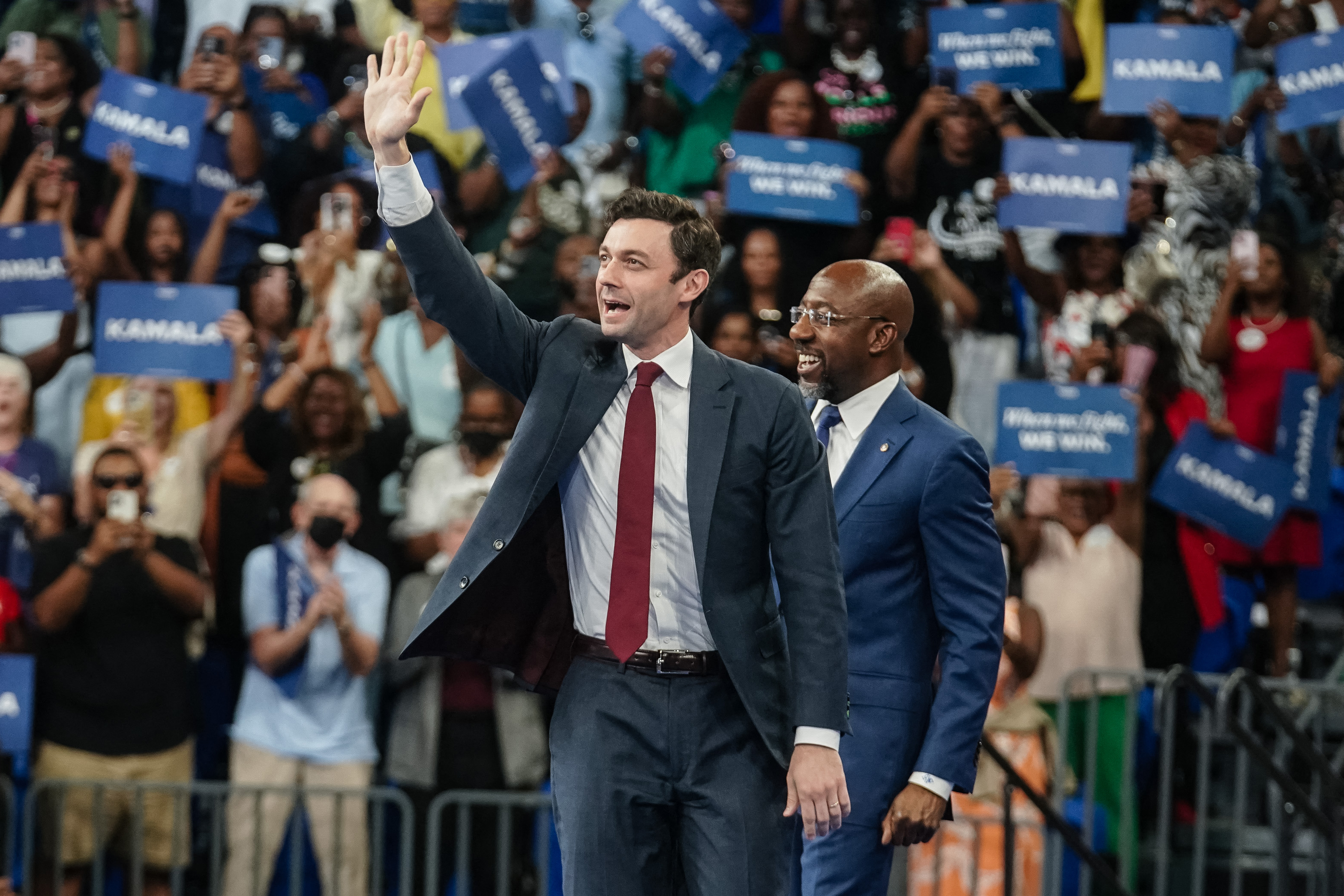
He was not there to announce a presidential campaign, but the scene had all the hallmarks of a candidate testing his message on the trail. Across town, Senator Raphael Warnock was delivering a sermon at Ebenezer Baptist Church, drawing on the same moral cadence that has made him one of the party’s most compelling orators. Both men, it seems, are quietly laying the groundwork for a national run.
The Democratic Party is staring at an open field for 2028, with no obvious heir apparent after President Biden’s expected departure from the national stage. In that vacuum, Jon Ossoff and Raphael Warnock have emerged as the two most strategically positioned figures to claim the mantle. Their shared geography is no coincidence. Georgia, once a reliably red state, has become the epicenter of Democratic ambition after delivering the party both Senate seats and a presidential victory in 2020.
Ossoff, 37, brings a youthful energy and a proven ability to raise staggering sums of money from small-dollar donors. His 2020 runoff campaign against David Perdue shattered spending records and demonstrated a mastery of digital organizing that national Democrats now covet. He has since focused on oversight of the executive branch and economic messaging aimed at working-class voters, a demographic the party has struggled to hold.
Warnock, 54, offers a different but equally potent profile. As the senior pastor of the church where Martin Luther King Jr. once preached, he carries an unmistakable moral authority. His 2022 runoff victory over Herschel Walker, in which he outperformed other Democrats on the ticket, proved his appeal extends well beyond the party’s base. In the Senate, he has championed voting rights and health care expansion, issues that resonate deeply with the party’s progressive wing.
The timing may be the decisive factor. With Vice President Kamala Harris’s political future uncertain and other potential candidates like Governors Gavin Newsom of California and Gretchen Whitmer of Michigan facing their own hurdles, the path for a Southern Democrat is clearer than it has been in decades. Both Ossoff and Warnock have demonstrated they can win in a state that is increasingly competitive but still leans conservative, a credential that could reassure party moderates worried about electability.
Of course, the road to the nomination is littered with early favorites who stumbled. Ossoff must contend with the perception that his Senate tenure has been more about investigation than legislation, while Warnock will need to balance the demands of the pulpit with the rigors of a national campaign. Neither man has publicly expressed interest in running, and both are focused on their current roles. But the infrastructure is quietly being built.
For now, Democratic insiders are watching Georgia closely. The two senators represent a generational and stylistic divide within the party, but they share a crucial advantage: they have already won the kind of tough, high-stakes elections that the national party desperately needs to replicate. Whether either man ultimately jumps into the race, their emergence as leading contenders signals a shift in the party’s center of gravity toward the Sun Belt.