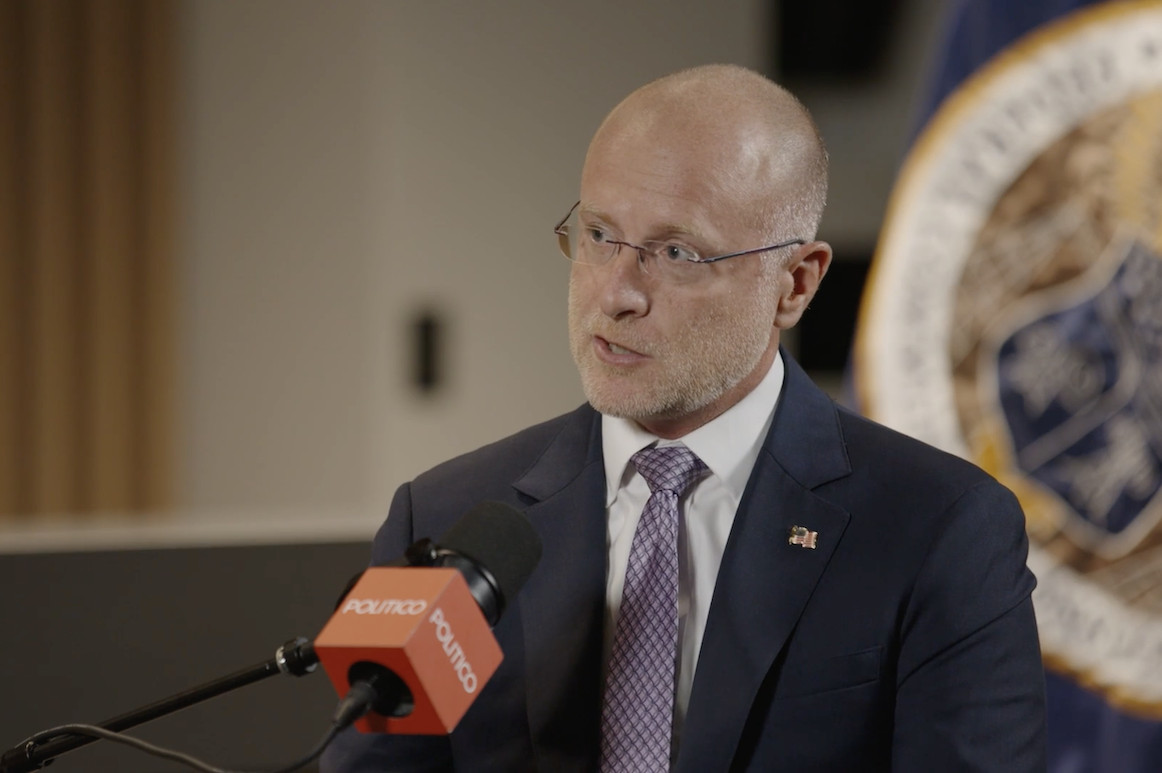
In a conversation with POLITICO’s Dasha Burns for the podcast “The Conversation,” Carr pushed back against accusations that his recent crackdowns on major broadcasters are designed to punish President Donald Trump’s political opponents.
“My view is not to take the gavel and weaponize it,” Carr said, according to a transcript of the interview posted Friday. “But my view is also not to take the gavel and bury it in the sand.” The remarks come as the chairman faces mounting alarm from both parties over a string of probes, enforcement actions and license reviews targeting high-profile media companies.
Among the targets are NBC, “60 Minutes,” Disney and “The View,” outlets that have drawn the administration’s ire. Carr, however, frames his actions as a return to statutory duty rather than political retribution. He pointed to a nearly century-old requirement that broadcasters, in exchange for their exclusive and federally granted licenses, must operate in the “public interest.”
“I don’t view the FCC as the speech police,” Carr said. “We should be appropriately applying and enforcing the laws that Congress passed.” His defense rests on the argument that the agency has drifted from its congressional mandate, a shift he believes has harmed the media landscape over the past two or three decades.
A Regulatory Reawakening
“I think in the media space in particular, the FCC over the last 20 or 30 years really backed away from the regulatory framework that Congress put in place,” Carr said. “And I don’t think it’s been a good thing, either.” That assessment marks a significant departure from the hands-off approach adopted by previous commissions of both parties, which largely treated broadcast content disputes as matters for the market or the courts.
Critics, however, see a more troubling motive. The investigations have landed squarely on programs and networks that have featured content unfavorable to the president, raising questions about whether the agency is being used as a tool of political intimidation. Carr’s insistence that he is merely enforcing existing law has done little to quell those concerns among detractors who fear a chilling effect on journalism.
The chairman’s comments highlight a central tension in his tenure: how to reconcile aggressive oversight with the First Amendment protections that shield the press. Carr argues that the public interest standard provides a legal basis for scrutiny, yet he offers no clear line between legitimate regulation and government overreach. For now, his actions suggest a willingness to push that boundary further than any recent predecessor.
As the probes proceed, the broadcast industry is watching closely. License renewals are the lifeblood of local stations, and the threat of revocation or conditions could reshape how networks approach editorial decisions. Carr’s interview did little to clarify how far he is willing to go, but it left no doubt that he sees his role as an enforcer, not a bystander.