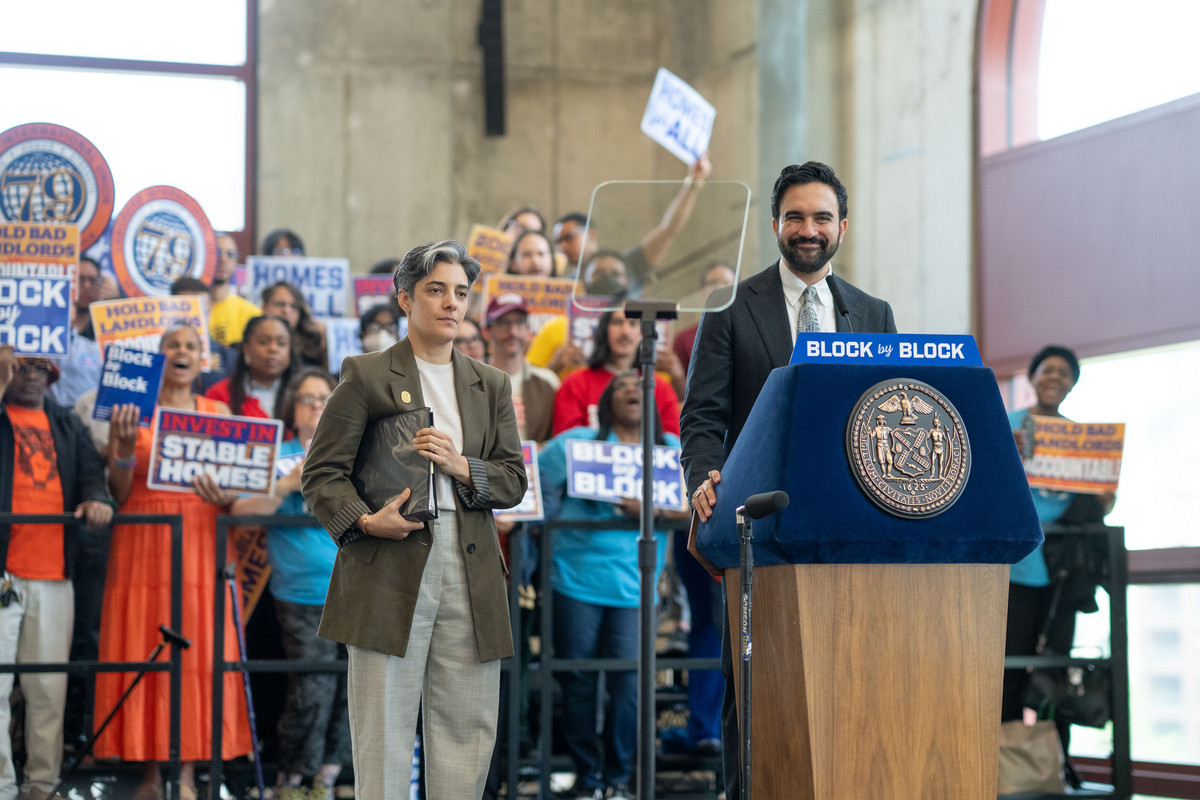
“If the absence of good government created the conditions we now face,” he told the crowd, “the presence of good government can build the solutions we now need.” The setting was deliberate: a neighborhood transformed by policy, offered as proof of concept for the far more ambitious work ahead.
The blueprint, titled Block by Block: The Housing Plan for a New Era, calls for the creation and preservation of a combined 400,000 affordable homes over the next decade. Mamdani framed the initiative as “the largest municipal housing transformation this country has ever seen,” directly confronting what his administration identifies as the central driver of New York City’s deepening affordability crisis. The plan arrives just months after a mayoral campaign that elevated housing to the top of the city’s political agenda.
Yet for all its sweeping rhetoric, the plan does not break entirely new ground. Mamdani is leaning heavily into policies championed by his predecessors, expanding existing programs rather than inventing new ones. The approach reflects a pragmatic recognition that the machinery of housing production, however slow and imperfect, can be scaled up more quickly than untested alternatives. The question is whether the city can muster the political will and financial discipline to make it happen.
Budget realities meet campaign promises
The plan confronts a tangle of overlapping crises: a severe shortage of available housing, a public housing system in physical decline with enormous capital needs, and a rental stock under growing financial distress as operating costs climb. Mamdani is standing by his campaign pledge to create 200,000 publicly subsidized homes over a decade, tripling current production rates, while also committing to preserve another 200,000 affordable units. The administration is aiming to produce roughly 14,000 affordable homes in fiscal year 2027, which begins July 1, and ramp up to 21,000 units annually by fiscal year 2031.
But the mayor is already encountering the limits of his own ambitions. The city’s strained municipal budget has forced his administration to moderate some of the costlier proposals floated on the campaign trail. Under the plan, the housing department will finance 8,000 new affordable homes in fiscal years 2027 and 2028, a more than 35 percent increase over the prior two years. The blueprint acknowledges the difficulty, stating plainly that “scaling to these levels of affordable housing production will not be easy and cannot be done overnight.”
Notably, the plan does not specify how the administration will produce the roughly 12,000 additional units needed each year to reach Mamdani’s 200,000 unit goal. Much of that gap, according to the document, will depend on zoning changes, tax incentives and other financing tools rather than direct city subsidies. That reliance on indirect levers of policy leaves significant room for uncertainty, particularly as opposition to new development remains fierce in many neighborhoods.
The mayor’s speech in Gowanus was a deliberate nod to what is possible when government acts decisively. Nearly five years after the area’s rezoning, the neighborhood has become a case study in how land use policy can spur residential construction. Mamdani is betting that same formula, applied citywide and supercharged with public investment, can deliver the transformation he has promised. Whether the numbers add up, and whether New Yorkers will accept the density required to meet them, remains the central test of his young administration.