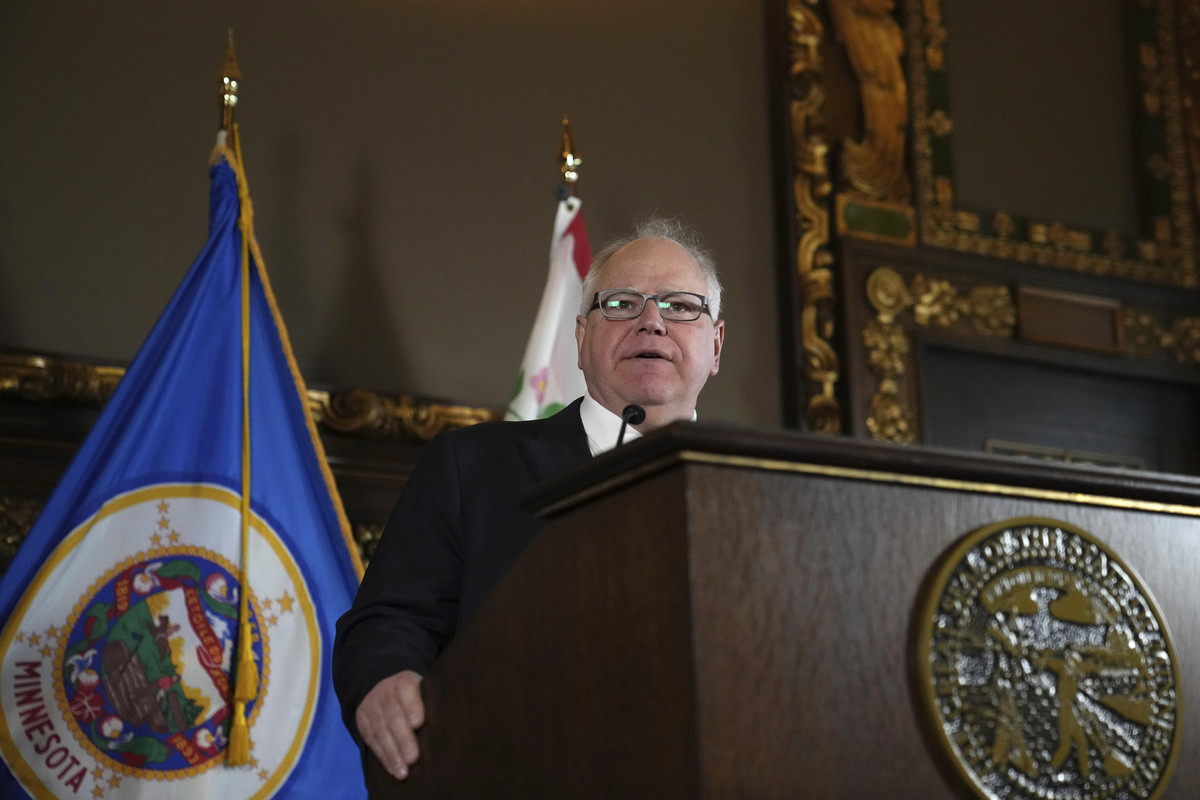
District Judge Patrick Schiltz threw out six grand jury subpoenas aimed at Minnesota Governor Tim Walz and other state and local officials, declaring that the Justice Department had launched a “blatantly unlawful” criminal investigation designed to punish the Democratic governor for refusing to assist President Donald Trump’s immigration crackdown.
“There is no doubt,” Schiltz wrote, that the subpoenas were part of a broader campaign to coerce Walz and other Minnesota officials into enforcing federal immigration laws. The George W. Bush appointee noted that the Trump administration’s repeated public attacks and promises of “retribution” against Walz “establishes beyond reasonable dispute” that the grand jury process was being weaponized for political ends.
The subpoenas were issued at the height of Operation Metro Surge, a federal enforcement action that sent thousands of immigration agents into the Twin Cities to carry out Trump’s mass deportation agenda. Federal prosecutors targeted Walz, the mayors of Minneapolis and St. Paul, the Minnesota attorney general, and commissioners of Hennepin and Ramsey counties. Schiltz found that the investigation was intended to punish Walz for his refusal to aid federal immigration enforcement, a position the Constitution protects because the federal government cannot compel states to enforce federal law.
“Initiating a criminal investigation in order to harass political opponents or to coerce them into taking official action, particularly official action that the federal government cannot directly require those political opponents to take, is a blatantly unlawful and unethical use of the grand jury process,” Schiltz wrote in the June 17 order, which was unsealed on Monday.
The judge linked the subpoenas to what he described as the Trump administration’s “well-established history” of using criminal investigations to retaliate against political adversaries. He pointed to a similar case involving Federal Reserve Chair Jay Powell, where another federal judge recently quashed subpoenas on the grounds that they were retaliatory. The Justice Department did not immediately respond to a request for comment on the ruling.
Walz celebrated the decision as “a victory for the rule of law and our democracy.” The ruling comes amid lingering public scrutiny of Operation Metro Surge, which led to tense street confrontations between federal agents and local residents. Two civilians, Renee Good and Alex Pretti, were killed by federal agents during those encounters, drawing national attention to the enforcement surge and contributing to a sharp decline in public support for Trump’s immigration agenda.
Schiltz’s ruling effectively blocks the Justice Department from using the subpoenas to compel testimony or documents from the named officials. Legal experts said the decision could have broader implications for other cases where the Trump administration has used federal criminal process against state and local leaders who resist cooperation with immigration enforcement. The judge emphasized that the Constitution’s anti-commandeering doctrine prevents the federal government from forcing states to administer federal programs, including immigration law.